Financialization and the Trivialization of Ethics Education: Dilemmas for University Accounting Programs
DOI:
https://doi.org/10.24142/rvc.n33a4Keywords:
ethics in public accounting, trivialization of teaching, financialization, ethical-political, professional regulationAbstract
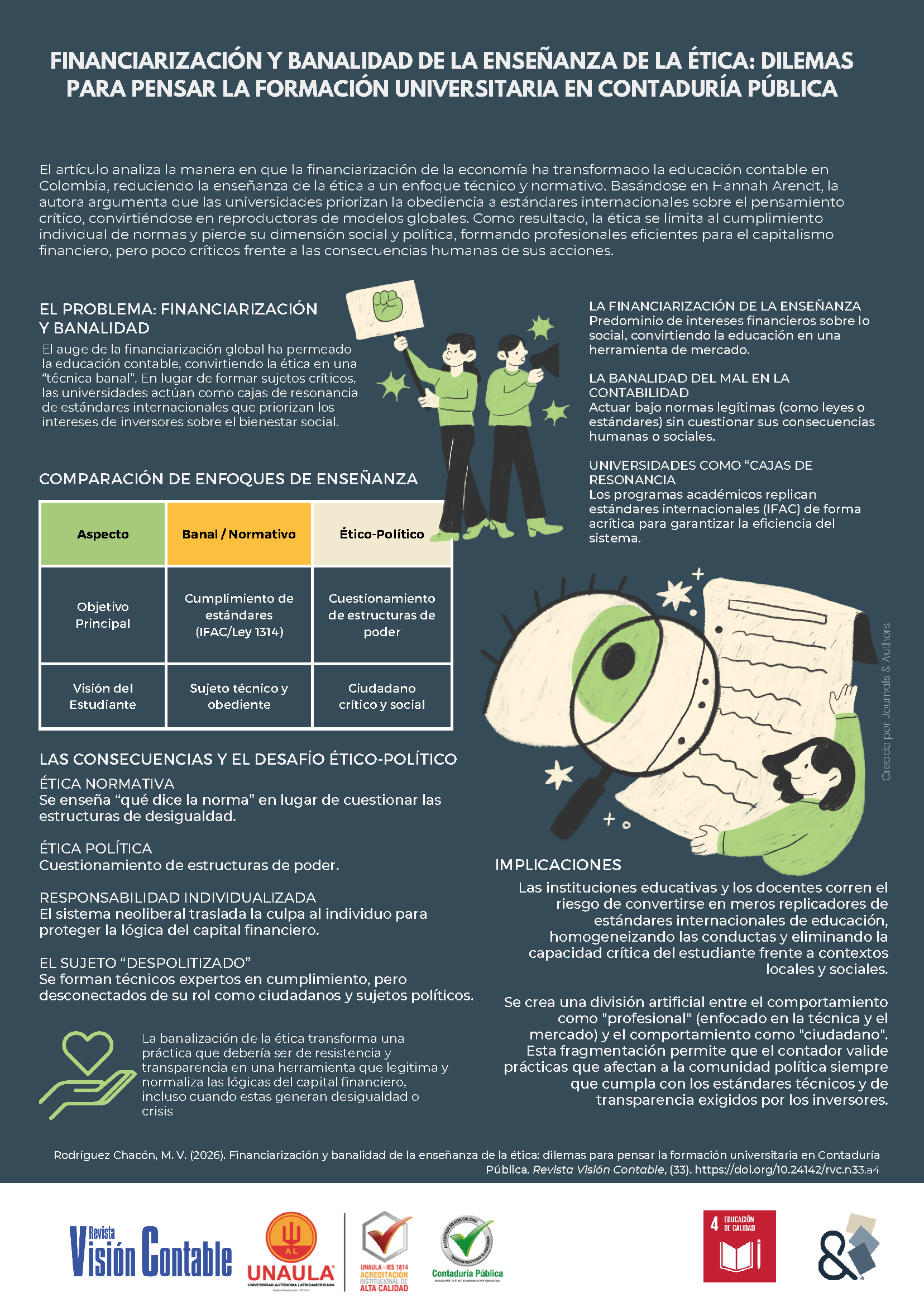
This article analyzes ethics teaching in public accounting as professional field in the context of financialization or financial globalization. It focuses on the impact of the international regulatory model on professional ethics teaching in public accounting programs at high-quality accredited universities in Bogotá, Colombia. It was found that the international financial context has permeated the discourses disseminated in the educational sphere, which are reinforced by professional regulations.
This study presents a literature review on ethics, teaching, and financialization in accounting. Likewise, a theoretical framework grounded in political theory, specifically the concept of trivializing teaching, is also provided. This study is qualitative in nature because it employs content analysis of semi-structured interviews and focus groups with professional ethics professors from those universities. The aim is to understand how financial ideologies are incorporated into ethics teaching. It concludes by stating that financialized capitalism has influenced academic programs and the accounting profession by homogenizing practices and behaviors and trivializing ethics teaching.
Downloads
References
Aglietta, M., & Rebérioux, A. (2009). El capitalismo financiero a la deriva: El debate sobre el gobierno de la empresa (F. Arbeláez, Trad.). Universidad Externado de Colombia.
Ahumada, C. (1996). El modelo neoliberal y su impacto en la sociedad colombiana. El Áncora Editores.
Arendt, H. (2004). Los orígenes del totalitarismo. Taurus.
Arendt, H. (2012). La condición humana. Paidós.
Arendt, H. (2019). Eichmann en Jerusalén: Un estudio sobre la banalidad del mal. Debolsillo.
Bardin, L. (1991). Análisis de contenido. Akal.
Bauman, Z. (2009). En busca de la política. Fondo de Cultura Económica.
Bedoya García, M. (2021). Evaluación del papel de la contabilidad en la subjetivación de los estudiantes universitarios en Colombia (2000–2015) [Tesis doctoral, Universidad Nacional de Colombia]. Repositorio Institucional Universidad Nacional de Colombia. https://repositorio.unal.edu.co/handle/unal/79935
Bilbeny, N. (1993). El idiota moral: La banalidad del mal en el siglo XX. Anagrama.
Boyer, R. (2013). Los financieros: ¿Destruirán el capitalismo? Miño y Dávila.
Brivot, M., Cho, C. H., & Kuhn, J. R. (2015). Marketing or parrhesia: A longitudinal study of AICPA’s shifting languages in times of turbulence. Critical Perspectives on Accounting, 31, 23–43. https://doi.org/10.1016/j.cpa.2015.04.001
Caglio, A., & Cameran, M. (2021). Educating the next generation of accountants: How to promote ethical consciousness through critical thinking. En M. Pinheiro & A. Costa (Eds.), Accounting ethics education: Teaching virtues and values (pp. 100–119). Routledge.
Chena, P., & Buccella, E. (2019). Financiarización, inestabilidad y crisis: Las consecuencias del valor financiero en la Argentina. En A. Márquez Velázquez & M. Soto Esquivel (Coords.), El imperio de las finanzas: Deuda y desigualdad (pp. 53–84). Universidad Nacional Autónoma de México.
Christensen, A. L., Cote, J., & Latham, C. K. (2018). Developing ethical confidence: The impact of action-oriented ethics instruction in an accounting curriculum. Journal of Business Ethics, 153(4), 1157–1175. https://doi.org/10.1007/s10551-016-3411-4
Correa, E. (2002). Nueva arquitectura financiera internacional: Reformas para los países en desarrollo y cosmética para las relaciones financieras internacionales. Comercio Exterior, 52(7), 616–626.
Cruz Kronfly, F. (2021). Subjetividad hipermoderna y capitalismo actual: Mirada crítica. Innovar, 31(79), 17–26. https://doi.org/10.15446/innovar.v31n79.91886
Engelen, E., Fernandez, R., & Hendrikse, R. (2014). How finance penetrates its other: A cautionary tale on the financialization of a Dutch university. Antipode, 46(4), 1072–1091. https://doi.org/10.1111/anti.12086
Fisher, M. (2016). Realismo capitalista: ¿No hay alternativa? Caja Negra.
Flax, J. (2013). Ética, política y mercado: En torno a las ficciones neoliberales. Universidad Nacional de General Sarmiento.
Fogarty, T. J. (2021). The long strange trip: A reflection on the historical relativity of accounting ethics. En M. Pinheiro & A. Costa (Eds.), Accounting ethics education: Teaching virtues and values (pp. 31–43). Routledge.
Galeano, M. E. (2018). Estrategias de investigación social cualitativa: El giro en la mirada. Fondo Editorial FCSH.
García, B. M., & Martín, A. S. (2013). La financiarización de la economía mundial: Hacia una caracterización. Revista de Economía Mundial, 33, 195–227.
Grebe, L., & Odendaal, E. (2017). Accounting research, education and practice: A social practice theory perspective. Southern African Journal of Accountability and Auditing Research, 19, 147–156.
Joshi, D. K., & Smith, W. C. (2012). Education and inequality: Implications of the World Bank’s Education Strategy 2020. International Perspectives on Education and Society, 16, 173–202. https://doi.org/10.1108/S1479-3679(2012)0000016013
Klees, S. J. (2012). World Bank and education: Ideological premises and ideological conclusions. International Perspectives on Education and Society, 16, 151–171. https://doi.org/10.1108/S1479-3679(2012)0000016012
Lapavitsas, C. (2011). El capitalismo financiarizado: Crisis y expropiación financiera. En C. Morera (Ed.), La crisis de la financiarización (pp. 33–90). Universidad Nacional Autónoma de México y CLACSO.
Lehman, C. R., & Okcabol, F. (2005). Accounting for crime. Critical Perspectives on Accounting, 16(5), 613–639. https://doi.org/10.1016/j.cpa.2003.08.003
León-Paime, E. (2016). Los profesores de contaduría pública como agentes estructuradores del campo contable en Colombia: Discursos y representaciones (1950–2009). Universidad Distrital Francisco José de Caldas.
Levy, N. (2010). Innovación financiera y crecimiento económico. Ola Financiera, 3(5), 71–101.
Low, M., Davey, H., & Hooper, K. (2008). Accounting scandals, ethical dilemmas and educational challenges. Critical Perspectives on Accounting, 19(2), 222–254. https://doi.org/10.1016/j.cpa.2006.05.010
Maman, D., & Rosenhek, Z. (2019). Responsibility, planning and risk management: Moralizing everyday finance through financial education. The British Journal of Sociology, 70(5), 1996–2019. https://doi.org/10.1111/1468-4446.12698
McPhail, K. (1999). The threat of ethical accountants: An application of Foucault’s concept of ethics to accounting education and some thoughts on ethically educating for the other. Critical Perspectives on Accounting, 10(6), 833–866. https://doi.org/10.1006/cpac.1998.0277
McPhail, K. (2001). The other objective of ethics education: Re-humanising the accounting profession—A study of ethics education in law, engineering, medicine and accountancy. Journal of Business Ethics, 34(3–4), 279–298. https://doi.org/10.1023/A:1012269015725
McPhail, K., & Walters, D. (2009). Accounting and business ethics: An introduction. Routledge.
Mintz, S. M., & Miller, W. F. (2021). The role of practical wisdom in accounting ethics education. En E. Z. Taylor & P. Williams (Eds.), The Routledge handbook of accounting ethics (pp. 281–294). Routledge.
Mosley, L. (2013). Interview research in political science. Cornell University Press.
Neu, D. (2003). Accounting for the banal: Financial techniques as softwares of colonialism. En A. Prasad (Ed.), Postcolonial theory and organizational analysis: A critical engagement (pp. 193–212). Palgrave Macmillan.
Neu, D., & Green, D. (2006). Truth or profit? The ethics and business of public accounting. University of Calgary Press.
Neu, D., Everett, J., & Rahaman, A. S. (2009). Accounting assemblages, desire, and the body without organs: A case study of international development lending in Latin America. Accounting, Auditing & Accountability Journal, 22(3), 319–350. https://doi.org/10.1108/09513570910945662
Nguyen, L. A., & Dellaportas, S. (2021). Accounting ethics education research: A historical review of accounting ethics. En M. Pinheiro & A. Costa (Eds.), Accounting ethics education: Teaching virtues and values (pp. 44–80). Routledge.
Orléan, A. (2006). El poder de las finanzas. Universidad Externado de Colombia.
Pullen, A., & Rhodes, C. (2015). Introduction: The inseparability of ethics and politics in organizations. En A. Pullen & C. Rhodes (Eds.), The Routledge companion to ethics, politics and organizations (pp. 1–9). Routledge.
Rajsingh, P. V. (2016). The global financial crisis and neo-liberal financialization. En S. Boubaker, D. Nguyen & H. Nguyen (Eds.), Corporate governance: Recent developments and new trends (pp. 57–73). Emerald. https://doi.org/10.1108/S2043-905920160000011003
Roberts, D. (2021). History of professional accounting ethics. En E. Z. Taylor & P. Williams (Eds.), The Routledge handbook of accounting ethics (pp. 9–25). Routledge.
Rodríguez Gómez, G., Gil Flores, J., & García Jiménez, E. (1999). Metodología de la investigación cualitativa. Aljibe.
Ryan, B., Scapens, R. W., & Theobald, M. (2004). Metodología de la investigación en finanzas y contabilidad (2.ª ed.). Deusto.
Simons, H. (2011). El estudio de caso: Teoría y práctica. Morata.
Tweedie, D., Dyball, M. C., Hazelton, J., & Wright, S. (2013). Teaching global ethical standards: A case and strategy for broadening the accounting ethics curriculum. Journal of Business Ethics, 115(1), 1–15. https://doi.org/10.1007/s10551-012-1364-9
Published
How to Cite
Issue
Section
License
Copyright (c) 2026 Revista Visión Contable

This work is licensed under a Creative Commons Attribution-NonCommercial 4.0 International License.
Aquellos autores/as que tengan publicaciones con esta revista, aceptan los términos siguientes:- Los autores/as conservarán sus derechos de autor y garantizarán a la revista el derecho de primera publicación de su obra, el cuál estará simultáneamente sujeto a la Licencia de reconocimiento de Creative Commons que permite a terceros compartir la obra siempre que se indique su autor y su primera publicación esta revista.
- Los autores/as podrán adoptar otros acuerdos de licencia no exclusiva de distribución de la versión de la obra publicada (p. ej.: depositarla en un archivo telemático institucional o publicarla en un volumen monográfico) siempre que se indique la publicación inicial en esta revista.
- Se permite y recomienda a los autores/as difundir su obra a través de Internet (p. ej.: en archivos telemáticos institucionales o en su página web) una vez sea publicado el artículo en la revista, lo cual puede producir intercambios interesantes y aumentar las citas de la obra publicada.